

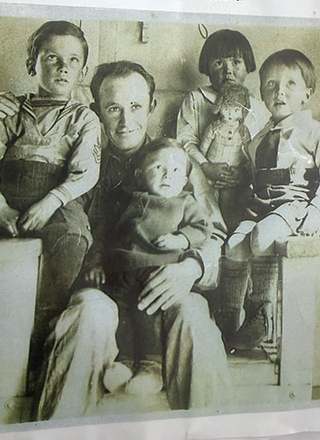
Paul-Eugène Birckel and his children, including his eldest son, Paul Birckel.
It is a story that seems straight out of a novel, where paths cross in unlikely ways. A young man leaves his native village in Alsace, France, for the wilderness of the Canadian Far North. Decades later, his son becomes one of the most respected and influential Indigenous leaders in Yukon history.
This is the fascinating story of the Birckel family, a very real saga in which the history of the Francophone world and the Yukon First Nations are woven together.
A departure driven by destiny
It all began early in the last century. In 1902, Paul-Eugène Birckel was born in the small village of Rombach-le-Franc in Alsace, France. Thousands of kilometres away, brothers Louis and Eugène Jacquot, also originally from Rombach, had settled in the Yukon. Having arrived in Dawson too late for the Klondike Gold Rush, they established themselves in Burwash Landing, where they ran a trading post and guided visitors through the backcountry. Their business was thriving.
Louis was married to Mary Copper Joe and Eugène to Ruth Dickson. They raised their families there, but at the turn of the 1930s, Louis Jacquot returned to France to provide an education for two of his children, Louis and Rosalie, since there was no school in Burwash Landing at the time. He also took the opportunity to look for workers.
He initially set his sights on a man named Joseph Estin. But fate had other plans, as recounted by Jean-Luc Fréchard, a French descendant of the Jacquot family: “Joseph Estin was engaged, and his fiancée didn’t want him to go to Canada.” On a whim, and with barely enough time to say goodbye to his loved ones, Paul-Eugène, Jacquot’s nephew, embarked on an adventure that would forever change his lineage and, with it, the history of the First Nations in the Haines Junction area. Accompanying him was a companion named Franck Bee, who ultimately left no descendants.
Once there, the young Alsatian worked hard. He tended to the livestock and cooked, even distinguishing himself during a glacier rescue mission to locate lost mountaineers. He later married Lilly (Lily) Allen, a woman from the Shadhäla yè Äshèyi Kwädän (Champagne Aishihik) First Nations. From this union, a son, Paul Jr., was born in 1938 on the shores of Kluane Lake, followed by Rosalie (Rose), Lucie, and Frank.
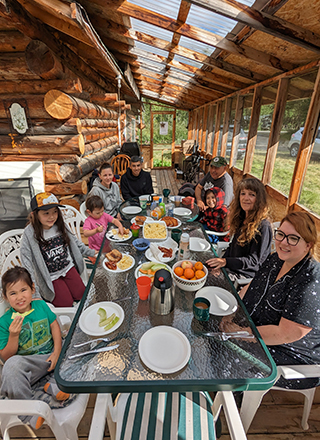
On the right, Gary Birckel (background) with one of his grandchildren, and Christine Rouvière (centre), during a family meal at the Klukshu cabin.
Paul Jr. becomes an Indigenous leader
Paul Jr. was raised in his mother’s culture. He worked as a mechanic in the oil fields and spent sixteen years at the Yukon Electrical Company, where he sometimes faced racism and discrimination that was prevalent at the time. He left his job in 1975 to dedicate himself to advocating for his people’s rights.
In 1978, he was elected Chief of the Champagne and Aishihik First Nations, a role he would passionately fulfill for 20 years. Monumental strides were made under his leadership. He negotiated one of the first land claim agreements in the Yukon with Ottawa; we can see his signature on the document, a copy of which can still be found today in the Yukon Indigenous history section at Yukon public libraries.
This peaceful struggle secured 2,400 square kilometres of land and $27 million for his nation, as well as an unprecedented self-government agreement that would become a model for all of Canada.
The legacy of this politician, who received the prestigious Indspire Award in 2000, extends even further. It includes the co-management of the Tatshenshini-Alsek Park, the creation of the Yukon Indigenous Language Centre, and significant progress regarding the protection of Indigenous children.
Who would have thought that the son of a Frenchman from France would have such a profound impact on the advancement of Indigenous rights?
A legacy at the crossroads
His connection to nature, inherited from his mother’s culture, was instinctive. His son Gary recalls a wilderness survival competition organized by the territorial government. Against all odds, Paul won it, without even using any instruments. “All he needed was to know the land and that moss grows only on one side of the trees,” he recalls.
He very nearly lost his French heritage. His father, Paul-Eugène, no longer spoke French and, therefore, passed little of it on to his children. Paul Jr. spoke English and understood Southern Tutchone, his mother’s language, but could no longer speak the language of Molière. His sister Rosalie (Rose) remembered a few French nursery rhymes, says Christine Rouvière (Paul Birckel’s cousin), but that is all.
Rebuilding the connection
As chance would have it, the woman who married Rose’s son was also born in France, bringing things full circle. Her name is Marianne Nowicki. “Rick [Paul Birckel’s nephew, Rose’s son] is very proud that our children are reconnecting with their French heritage. He doesn’t speak French, but he understands a bit when I speak to the kids. I speak to my children in French, and since we live in the forest near Dezadeash Lake, Rick also teaches them his way of life.”
Marianne, Christine, Jean-Luc, Rose, Maureen, and Gary… All of them have since reconnected.
Sometimes it was coincidental, like when Christine’s father read the story of his cousin in a local Alsatian newspaper. “My grandmother often spoke to me about this cousin [Paul-Eugène] who had gone off to Canada to look for gold. I was little, and I hoped he would come back one day and give us some,” she recalls with a laugh. “But he didn’t return, and the family ties were lost.” So, when her father showed her the local Alsatian newspaper article, she began researching her family tree and found a phone number. She called Paul, her second cousin (their grandmothers were sisters), and explained who she was in broken English. Less than five minutes later, he contacted her by fax, re-establishing the connection. She was subsequently invited to the Yukon several times.
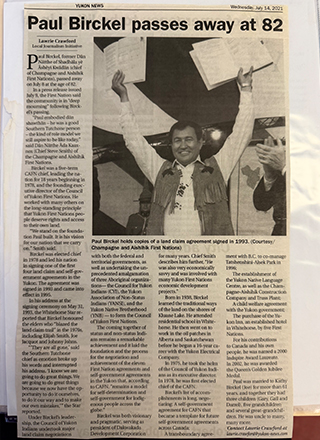
Photo of Paul Birckel published in the Yukon News in 1993.
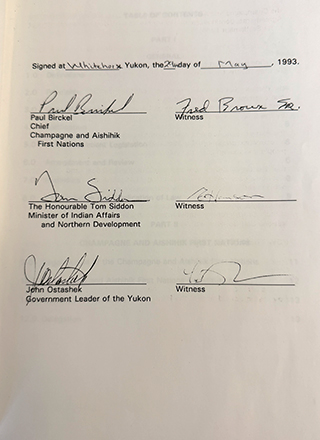
Paul Birckel was the signatory of the 1993 land claim agreement for the Champagne and Aishihik First Nations.
At other times, it was Yann Herry, historian and president of the Yukon Francophone Historical Society, who maintained this link. Before he passed away, Paul Birckel handed him a large box containing all his correspondence, Christmas cards, faxes, and birth certificates. “There you go,” he said. “I don’t speak French, so I’m leaving them with you.” Since then, Yann Herry has organized the documents and hosted descendants of the Jacquot and Birckel families on several occasions, arranging visits to Haines, Haines Junction, and Klukshu, as well as tours across the territory.
In 2009, for instance, thirteen cousins from Alsace travelled from Europe to meet their relatives in Alaska and the Yukon. The highlight of this reunion took place at Paul’s traditional salmon fishing camp in Klukshu. Against this majestic backdrop, the Indigenous chief explained the ancestral workings of the fish trap to his overseas cousins. Over a shared salmon meal in log cabins, two worlds that seemed worlds apart celebrated the family bond uniting them.
Christine Rouvière, too, received this generous and warm welcome. “The first time I arrived, I asked myself, ‘What am I doing here? I’m no adventurer!’ It took me two days to adjust, but the welcome was incredible! I formed a strong bond with Paul.”
In 2025, another group from the Alsatian family returned to the Yukon. During a traditional gathering near Burwash Landing, French visitors were struck by the depth of this heritage. Jean-Luc Fréchard, who was part of the trip, recalls the moment the camp leader asked the gathering: “Are there any descendants of the Birckels here?” Three quarters of the people in that camp raised their hands. It was a very powerful moment.
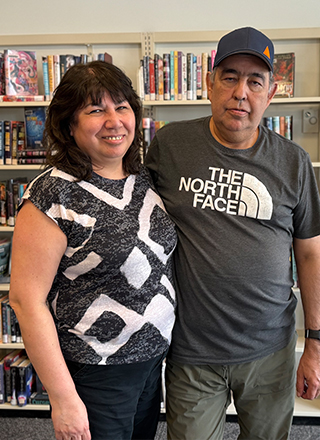
Gary Birckel and his wife Maureen remember Paul Birckel as a man who enjoyed living “on the land,” rather than as a politician. They have stayed in touch with Christine Rouvière, whom they have met again in both France and the Yukon.
Paul: family man and leader
Paul Birckel passed away on July 8, 2021, at the age of 82. He was survived by his wife, Kathleen (Kathy), a Southern Tutchone teacher with whom he shared 61 years of his life, and their three children: Gary, Gail, and Darrell.
His son Gary and daughter-in-law Maureen Birckel describe a father and grandfather deeply connected to the traditions of the land, rather than just a chief. “He didn’t talk much about work at home.”
“We spent a lot of time together, mostly in the cabins at Klukshu or elsewhere, hunting and fishing… He often took our eldest son out into the wild and taught him a great deal; they were very close. That is the Indigenous tradition.”
On the other hand, Christine Rouvière was struck by the man’s political dedication: “Sometimes Paul would take naps during the day. He told me it was because he didn’t get enough sleep at night. When I asked why, he said it was because he was thinking about his people, and about everything that needed to be done for their culture and their lands.”
Paul helped “forge stronger family ties between the Yukon and France,” observes Yann Herry. He emphasizes that “the history of the Francophone community and the history of the First Nations are completely interconnected.” Far from being isolated from one another, these communities were intimately bound together by the love, adventure, and courage of pioneers and leaders who knew how to break down barriers.
Chief Paul Birckel served as a living link between a humble family from Rombach-le-Franc and the powerful resilience of Yukon First Nations. His cousin Christine Rouvière sums it up movingly: “He was the greatest of men.”
A few terms to know
A trading post is a commercial establishment serving as an exchange point where merchants traded manufactured goods for local resources, such as animal hides or furs.
A land claim agreement is a treaty negotiated between Indigenous peoples and governments. It clearly defines rights related to land, natural resources, and, often, self-government. These agreements constitutionally protect ancestral rights and have the force of law.


Les commentaires s'afficheront une fois que vous aurez atteint la fin de l'article.